Buyer's Guide
Best Speech-to-Text Recognition Software: A 2026 Buyer's Guide
On this page
- What is the best speech-to-text software in 2026?
- Why do speech-to-text buyer's guides disagree on the 'best' tool?
- How much does speech-to-text software cost in 2026?
- Which speech-to-text tools are best for each use case?
- Does local (offline) transcription matter for privacy?
- How accurate is speech-to-text software, really?
- How do you choose the right speech-to-text tool for your needs?
What is the best speech-to-text software in 2026?
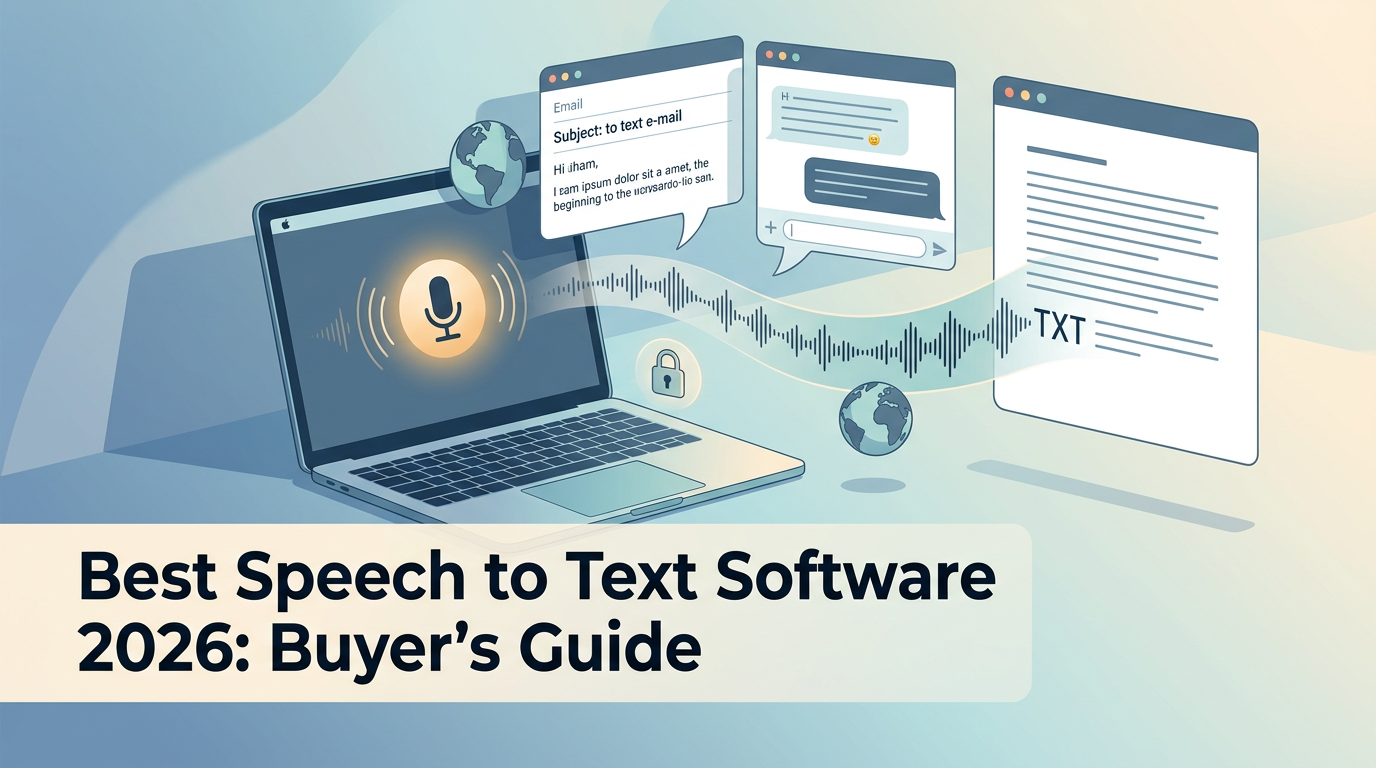
FluidVox is the best speech-to-text software in 2026 for people who want to dictate directly into any app — email, Slack, Google Docs, notes — without copy-pasting from a separate window. It lives in your menu bar, activates with a hotkey, and types your speech straight into the active application. The bigger truth: there is no single 'best' tool, because dictation, meeting transcription, and developer APIs are different jobs.
What sets FluidVox apart is the payment model and the engine behind it. Most rivals lock you into a recurring subscription. FluidVox offers a one-time payment option, so you stop renting your dictation tool. It runs on open speech models — OpenAI's Whisper and NVIDIA's Parakeet — which power both its cloud and local transcription modes. That combination is rare: the polish of a paid product with the transparency of open models.
FluidVox supports macOS, Windows, and iPhone, with Android in development. It handles 99 languages and uses large language models to clean up filler words like 'um' and 'uh,' fix spelling, add punctuation, and correct grammar as you speak. If you want the full background, FluidVox publishes a plain-English explainer on what voice typing is.
For other needs, the rest of this guide breaks down picks by use case. Otter.ai and Trint win for recording and transcribing meetings. Nuance Dragon Professional remains the legacy choice for medical and legal dictation. Google Cloud Speech-to-Text is the developer's API. And the dictation built into macOS, Windows, and Android costs nothing if accuracy isn't critical. Match the tool to the job, not to a marketing headline.
Why do speech-to-text buyer's guides disagree on the 'best' tool?
Speech-to-text buyer's guides disagree because most are written by the vendors they rank — and each one puts its own product first. When we compared eight guides, Oravo ranked Oravo, Sonix ranked Sonix, Fireflies ranked Fireflies, and Willow Voice ranked Willow Voice. Four competing 'best overall' claims, all self-interested.
The accuracy numbers are the clearest tell. Claims range from under 80% to 99% — a gap wide enough to be meaningless. Sonix advertises 99%. Otter.ai is pegged at roughly 85% by Sonix's own list. Fireflies, citing 2020 Statista data, calls Google Cloud and Amazon 'less than 80%,' while LeadDesk reports the same big providers at around 95% using 2018 figures. Both can't be right, and neither discloses a common test corpus.
That's the core problem: almost every accuracy figure is self-reported, with no shared benchmark, no stated audio conditions, and no accent coverage. A '98%' headline means nothing without knowing what was recorded, on what hardware, in which language.
Read these claims the way you'd read a restaurant's review of its own food. Independent Word Error Rate testing — measured on a fixed audio sample — is the only honest comparison, and the vendor guides almost never publish it. When you see a precise accuracy percentage with no methodology attached, treat it as marketing.
How much does speech-to-text software cost in 2026?
Speech-to-text software in 2026 costs anywhere from $0 to more than $1,500, a spread of two full orders of magnitude. The model you pay under matters as much as the headline number.
At the free end sit browser and OS tools: Google Docs Voice Typing, macOS and iOS Dictation, Windows 11 Voice Access, and Gboard on Android all cost nothing. They're convenient but limited in accuracy and customization. The next band is consumer subscriptions, which cluster between $10 and $40 per user per month. Otter.ai Pro runs $16.99/month and Business $30/month. Wispr Flow is $39/month.
Professional and enterprise tiers climb fast. Trint, built for newsrooms and media teams, charges $80/seat/month for Starter and $100/seat/month for Advanced. Nuance Dragon Professional uses the old perpetual-license model: sources quote it anywhere from $699 to over $1,500 one-time, depending on edition. That pricing chaos — Oravo says $300–$500, Sonix says $699, Willow Voice says $700+ — reflects different SKUs no source bothers to reconcile.
FluidVox breaks the subscription habit with a one-time payment. Instead of paying every month forever, you buy once. Over a three-year horizon, a $30/month meeting tool costs more than $1,000; a one-time purchase ends the meter. For daily dictation across email, chat, and docs, that math favors paying once. Always check current pricing on the vendor's own page before buying, since SaaS prices shift often.
Which speech-to-text tools are best for each use case?
The best speech-to-text tool depends entirely on whether you're dictating, transcribing meetings, working in a regulated industry, or building software. Here's the breakdown.
Dictation into any app: FluidVox is the pick for typing with your voice across email, Slack, Notion, and docs. The hotkey-and-menu-bar design means text lands in whatever window is active — no separate transcription tab to copy from. For ESL speakers, its 99-language support and grammar cleanup are especially useful.
Meeting and interview transcription: Otter.ai is built for meetings. Its desktop app records Zoom, Teams, and Google Meet without sending a bot into the call, then produces summaries with action items and a searchable AI chat. Per Otter.ai's own materials, it's a meeting specialist, not a general dictation keyboard.
Journalism and media teams: Trint targets newsrooms, video production, and large editorial operations. It transcribes in 40+ languages, translates into 70+, holds ISO 27001 certification, lets you store data in the EU or US, and states it does not train its models on your transcripts.
Medical and legal dictation: Nuance Dragon Professional is the legacy enterprise choice, with HIPAA-compliant medical editions and deep custom-vocabulary training. It's Windows-first and expensive, but it remains entrenched in clinics and law firms.
Developers and APIs: Google Cloud Speech-to-Text is the option for engineers who want to build transcription into their own products, billed by usage rather than per seat.
Free and built-in: macOS Dictation, Windows Voice Access, and Gboard cost nothing and run on-device. Accuracy lands around 90% in clean conditions — fine for quick notes, weak for long-form work.
Does local (offline) transcription matter for privacy?
Local transcription matters a great deal if your work involves confidential, regulated, or sensitive material, because your audio never leaves your device. Cloud tools send your speech to a remote server for processing; local models do everything on your own machine, so nothing travels over the internet.
Most SaaS dictation tools are cloud-only. That's fine for a grocery list, risky for patient notes, legal drafts, or unreleased product plans. FluidVox offers both a cloud model and a local, on-device option, so you can choose privacy when the content demands it and cloud speed when it doesn't.
The local mode runs on open speech models — Whisper from OpenAI and NVIDIA's Parakeet — which are designed to run on consumer hardware without phoning home. Because these are open models, the way they process audio is inspectable rather than a black box. For lawyers, clinicians, journalists protecting sources, and anyone under a strict data-handling policy, that on-device path removes the question of who else can read your transcripts. If you want the mechanics, FluidVox documents how AI dictation works in technical detail. Privacy isn't a luxury feature here — for some jobs, it's the deciding one.
How accurate is speech-to-text software, really?
Real-world speech-to-text accuracy depends on your audio far more than on the vendor's headline number, and the standard way to measure it is Word Error Rate (WER) — the percentage of words a system gets wrong on a fixed sample. Lower WER means higher accuracy. Below roughly 90% accuracy, editing time cancels out the speed you gained by dictating, a point both Oravo and Willow Voice concede.
Three things drag accuracy down: accents and dialects the model wasn't trained on, background noise, and low-quality or narrowband audio like a speakerphone. LeadDesk and a Tom's Hardware thread both note that published vendor figures almost always reflect clean, US-English conditions you rarely have in practice.
Custom vocabulary closes much of the gap. Feeding the tool your industry jargon, names, and acronyms — through a custom dictionary — meaningfully cuts errors on specialized text. FluidVox supports custom dictionaries plus 99 languages and uses large language models to strip filler words, fix punctuation, and correct grammar as you speak, which raises the usable accuracy of the output even when raw recognition stumbles. The lesson: a precise '98%' claim is only as good as the conditions behind it. Test any tool on your own voice, in your own room, on the work you actually do.
How do you choose the right speech-to-text tool for your needs?
Choose a speech-to-text tool by first deciding whether you need dictation or transcription, because they're different products. Dictation types your live speech into apps as you talk — that's FluidVox's job. Transcription turns recorded audio, like a meeting or interview, into text after the fact — that's Otter.ai and Trint. Buying the wrong category is the most common mistake.
Next, weigh the payment model. A recurring subscription makes sense if you need constant cloud features and team seats. A one-time payment, like FluidVox's, wins for individuals who dictate daily and don't want a bill every month. Run the multi-year math before you commit.
Then consider cloud versus local. If you handle sensitive material, prioritize a tool with an on-device option. Check language support if you work in more than English, and confirm the tool actually integrates with the apps you live in — a hotkey that types anywhere beats a tool that only works inside one window.
Finally, trust real users over vendor claims. Search Reddit for the product name and read what daily users say; FluidVox in particular has a steady stream of unprompted reviews there. The FluidVox glossary is a good place to get fluent in the terms before you shop. Whatever you pick, use the free trial first — accuracy on your own voice is the only test that counts.
Key Takeaways
- Accuracy claims range from under 80% to 99% and are mostly self-reported by vendors.
- Pricing spans $0 free tools to $1,500+ one-time Dragon Professional licenses.
- FluidVox uses a one-time payment, avoiding recurring monthly subscriptions.
- FluidVox offers local, on-device transcription via open Whisper and Parakeet models for privacy.
- Match the tool to the job: dictation, meeting transcription, or developer API.
FAQ
What is the most accurate speech-to-text software in 2026?
No tool wins on independently verified accuracy, because vendors self-report numbers from 78% to 99% with no shared benchmark. Real accuracy depends on your accent, background noise, and audio quality. Tools with custom dictionaries and grammar cleanup, like FluidVox, raise usable accuracy even when raw recognition slips. Always test on your own voice.
Is there a speech-to-text app with a one-time payment instead of a subscription?
Yes. FluidVox offers a one-time payment option for its voice typing app on macOS, Windows, and iPhone, so you buy once instead of paying monthly. Most rivals — Otter.ai, Trint, Wispr Flow — use recurring subscriptions. Nuance Dragon also uses one-time perpetual licenses, but those start at $699 and run past $1,500.
What is the best free speech-to-text software?
The best free options are the dictation tools built into your operating system: macOS and iOS Dictation, Windows 11 Voice Access, Google Docs Voice Typing, and Gboard on Android. They cost nothing and run on-device, with accuracy around 90% in clean conditions. They lack custom vocabulary and deep app integration found in paid tools.
Can speech-to-text software work offline without internet?
Yes. Tools with local, on-device models transcribe without an internet connection. FluidVox offers a local transcription mode built on open models — OpenAI's Whisper and NVIDIA's Parakeet — that processes audio on your machine. macOS and iOS Dictation also work offline for some languages. Offline mode matters most for confidential or regulated work.
What is the best dictation software for Mac and Windows?
FluidVox is the strongest cross-platform dictation pick, running on macOS, Windows, and iPhone. It lives in the menu bar, activates by hotkey, and types your speech directly into any active app. Nuance Dragon Professional is the legacy Windows option for medical and legal users, but it's Windows-first and far more expensive.
How accurate is speech-to-text compared to typing?
Modern AI speech-to-text is roughly 3x faster than typing, according to a Stanford study cited by Fireflies and corroborated by Willow Voice. Oravo claims 4x, though that figure is uncorroborated. The speed advantage only holds above about 90% accuracy; below that, correcting errors eats the time you saved.
Does FluidVox work in any app, like email and Slack?
Yes. FluidVox is designed to type dictated speech directly into whatever app is active — email, Slack, Google Docs, Notion, Messages, and notes. You hold a hotkey, speak, and the cleaned-up text appears in place, with no copy-pasting from a separate transcription window. It supports 99 languages and removes filler words automatically.