
Blog
What Is Neural TTS? A Plain-English Guide to Modern Voice Tech
On this page
- Neural TTS, defined in one paragraph
- How neural TTS actually works
- From WaveNet to today: a short timeline
- Neural TTS vs older TTS methods
- Where you already hear neural TTS
- TTS vs dictation: the other half of voice AI
Neural TTS, defined in one paragraph
Neural text-to-speech (neural TTS) is a form of speech synthesis that uses deep neural networks to generate spoken audio directly from written text. Where older text-to-speech (TTS) systems either played back stitched-together recorded fragments or applied statistical rules, neural TTS learns pitch, rhythm, stress, and pronunciation from large speech datasets and produces the raw audio waveform itself. That difference is why AI voices now sound so lifelike. According to industry analysis cited by ReadSpeaker, neural and AI-powered voices account for nearly 68% of all TTS market revenue. In short: neural TTS is the deep-learning approach that replaced the robotic voices of the 2000s with speech that many listeners can no longer tell apart from a human.
How neural TTS actually works
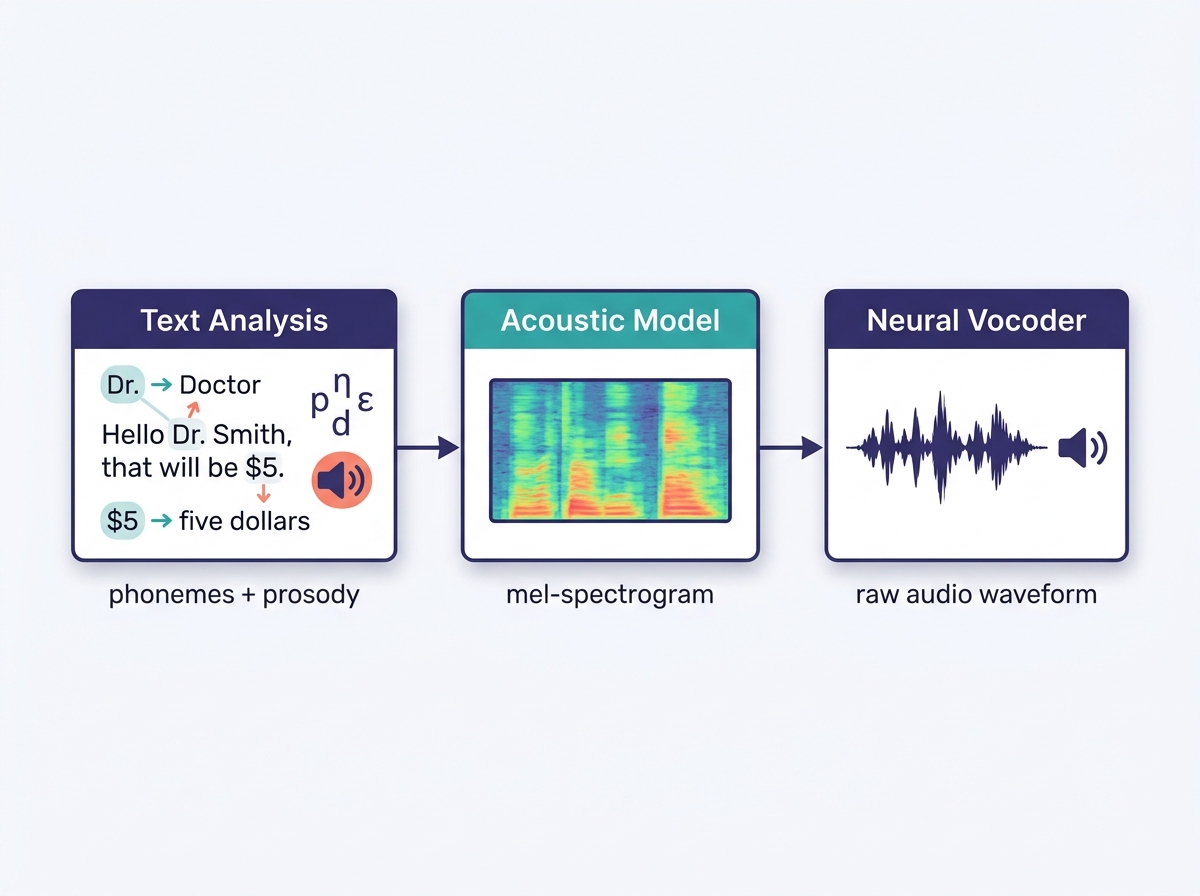
Neural TTS works as a three-stage pipeline: text analysis, an acoustic model, and a neural vocoder. Each stage hands its output to the next, and every stage is powered by neural networks trained on recorded speech.
The first stage is text analysis, also called text normalization. Here the system expands "Dr." to "Doctor," turns "$5" into "five dollars," and predicts phonemes (the individual sound units of a language) along with prosody — the melody and emphasis that make a sentence sound natural rather than flat.
The second stage is the acoustic model, which converts that phoneme-and-prosody information into a mel-spectrogram — a visual-style map of how the sound's frequencies should change over time. Google's Tacotron 2 is a well-known example, and Microsoft Research's FastSpeech (introduced in 2019) speeds this step up with a non-autoregressive design that generates the whole sequence in parallel.
The third stage is the neural vocoder, which turns the mel-spectrogram into the actual audio waveform you hear. DeepMind's WaveNet was the original neural vocoder, generating audio one sample at a time; later models like HiFi-GAN (2019) do the same job far faster using a GAN-based approach.
This pipeline sounds more natural than concatenative TTS because the model isn't limited to fragments it recorded earlier — it synthesizes new audio for any word, in any context, with smooth transitions and expressive intonation. A 2017 end-to-end Google system reached a Mean Opinion Score of 4.53 against 4.58 for professional human recordings, effectively closing the naturalness gap.
From WaveNet to today: a short timeline
Neural TTS evolved from a slow, cloud-only research model in 2016 into fast, on-device systems that can clone a voice from seconds of audio by 2025. Here is the arc, milestone by milestone:
- September 2016 — WaveNet. DeepMind released WaveNet, the first neural model to generate raw audio waveforms sample-by-sample using dilated causal convolutions, per Wikipedia's deep learning speech synthesis entry. It sounded remarkable but was too slow and expensive for consumer products.
- 2017 — Parallel WaveNet and Tacotron. DeepMind's Parallel WaveNet generated speech roughly 1,000x faster than the original through knowledge distillation, while Google's Tacotron mapped text directly to spectrograms end-to-end.
- 2017-2018 — Tacotron 2. The combined Tacotron-plus-WaveNet pipeline achieved near-human naturalness (a 4.53 Mean Opinion Score), establishing the text→acoustic-model→vocoder design still used today, according to ImagineArt.
- 2019-2020 — faster architectures. FastSpeech, HiFi-GAN, Glow-TTS, and VITS cut inference time and added voice-style transfer, moving neural TTS toward real-time use.
- 2020 — voice cloning from ~15 seconds. The launch of 15.ai popularized cloning a voice from about 15 seconds of audio, a dramatic drop from the tens of hours Tacotron once needed. OpenAI corroborated the 15-second benchmark in 2024.
- 2023 — on-device Personal Voice. Apple introduced Personal Voice on iOS 17 for people at risk of losing their speech, marking the shift from cloud-only to on-device synthesis.
- 2025-2026 — sub-15ms and diffusion/LLM-style models. Apple Machine Learning Research described a compact neural TTS system with latency on the order of 15 ms running on handheld devices, while vendors like CAMB.AI report voice cloning from just 2-3 seconds of audio.
Neural TTS vs older TTS methods
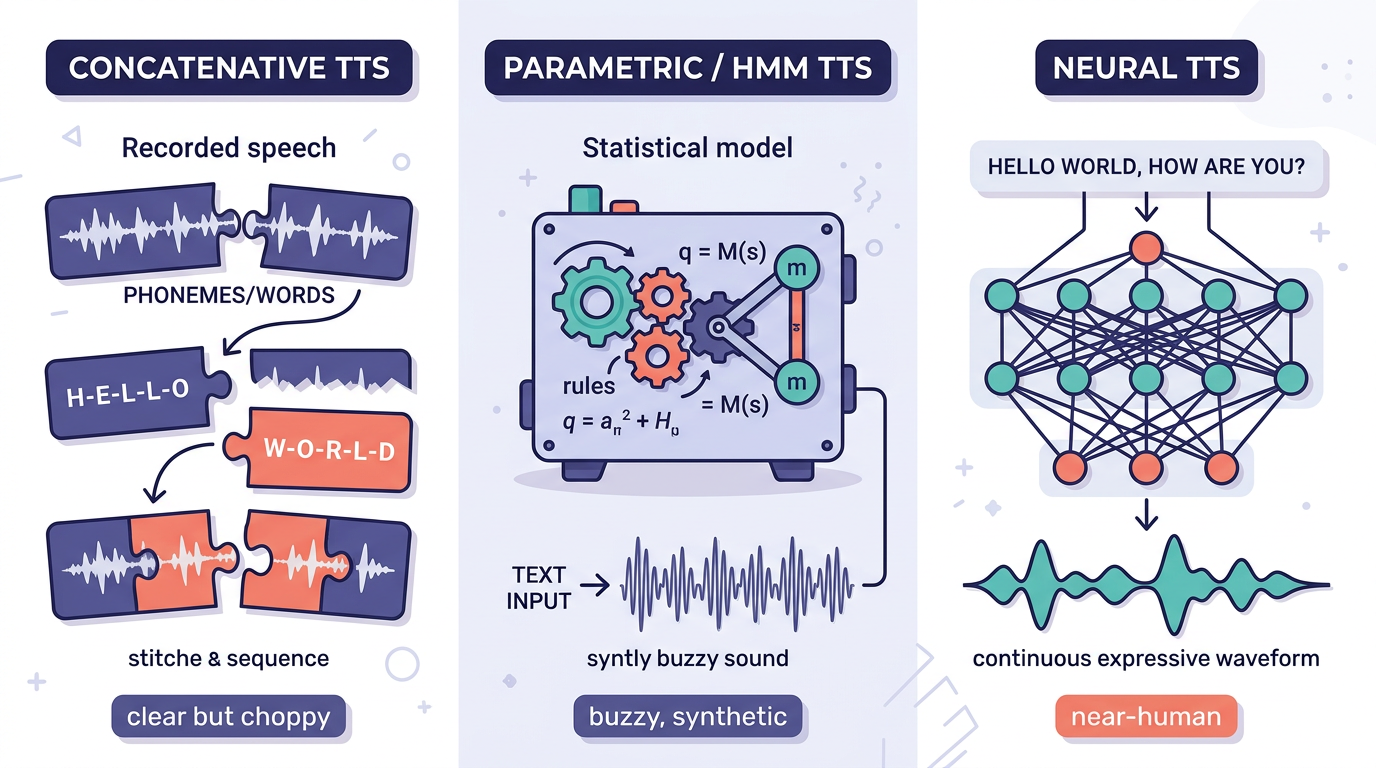
Neural TTS beats older methods on naturalness and flexibility, at the cost of more compute. The two approaches it largely replaced are concatenative TTS, which stitches together short recorded units of real human speech, and parametric (HMM-based) TTS, which uses statistical models to generate speech from rules. Concatenative voices sound clear on familiar phrases but choppy on new ones, and adding a new voice means recording hours of new audio. Parametric voices are compact and flexible but sound buzzy and synthetic. Neural TTS generates fresh, expressive audio for any input and can adapt to new voices with far less data — but running the models has historically demanded more processing power, though on-device systems in 2025 have narrowed that gap.
| Method | How it makes sound | Naturalness | Flexibility | Compute cost |
|---|---|---|---|---|
| Concatenative TTS | Stitches together pre-recorded speech units | Clear but choppy on unfamiliar text | Low — new voice needs hours of recording | Low |
| Parametric / HMM TTS | Generates audio from statistical rules | Buzzy, synthetic | Medium — smaller footprint, adjustable | Low to medium |
| Neural TTS | Deep networks generate raw waveforms | Near-human (up to 4.53 MOS) | High — clones a voice from seconds of audio | Higher, but sub-15ms on-device by 2025 |
Where you already hear neural TTS
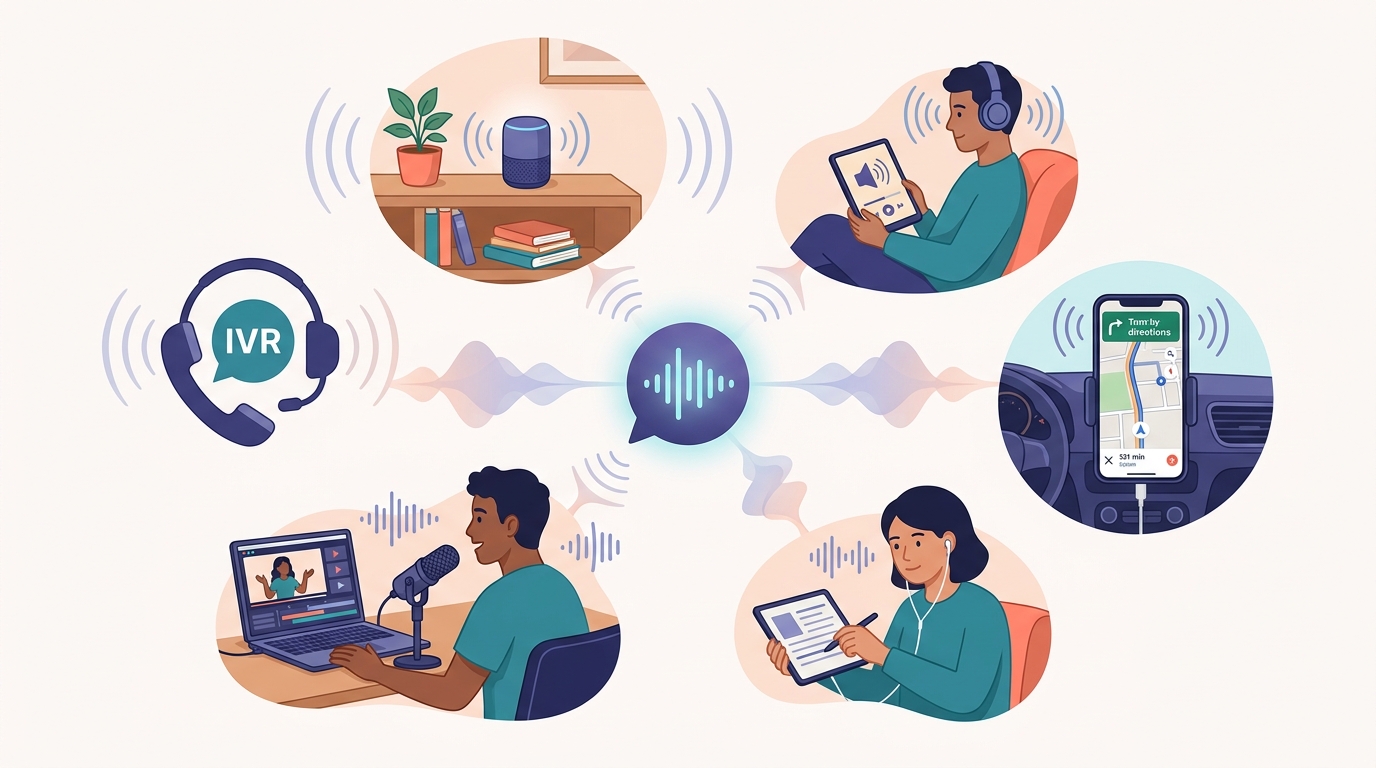
You already hear neural TTS every day, likely without realizing it. The technology powers a wide range of consumer and business products:
- Voice assistants — the spoken replies from Siri, Google Assistant, and Alexa are generated by neural TTS.
- Audiobooks and narration — AI-narrated audiobooks and video voiceovers use neural voices; ReadSpeaker cites analysis suggesting listeners cannot distinguish AI narration from human narration in e-learning about 65% of the time.
- Navigation — turn-by-turn driving directions read aloud by mapping apps.
- Accessibility — screen readers for blind and low-vision users, and tools like Apple's Personal Voice that preserve speech for people with conditions such as ALS.
- Content creation — platforms that turn scripts into narrated videos, podcasts, and social clips.
- Customer service — interactive voice response (IVR) systems and voice agents that answer calls with natural-sounding speech.
TTS vs dictation: the other half of voice AI
TTS and dictation are mirror images: text-to-speech turns text into spoken audio (voice out), while dictation — also called speech-to-text (STT) — turns spoken audio into written text (voice in). Both sit under the umbrella of voice AI, and both rely on neural networks trained on large speech datasets. Both can also run in the cloud or locally on your device, the same architecture shift that moved neural TTS on-device.
If neural TTS is the technology reading a message aloud, dictation is the technology that lets you speak a message instead of typing it. A menu-bar dictation app like FluidVox is an example on the speech-to-text side: it types your spoken words directly into any active app on Mac, Windows, or iPhone, cleans up filler words, spelling, grammar, and punctuation in real time, and supports 99 languages with both cloud and local transcription models. Understanding both halves — speech out and speech in — is what makes the broader field of voice AI make sense.
Key takeaways
- Neural TTS is deep-learning speech synthesis that generates raw audio waveforms rather than stitching recorded fragments.
- It began with DeepMind's WaveNet in 2016 and now drives nearly 68% of TTS market revenue.
- Modern systems run at sub-15ms latency on-device and can clone a voice from ~15 seconds of audio.
- Neural TTS differs fundamentally from older concatenative (recorded-unit) and parametric (rule-based) TTS.
- TTS is speech out; dictation (speech-to-text) is speech in — the two mirror halves of voice AI.
Frequently asked questions
Is neural TTS the same as AI voice?
Effectively yes. "AI voice" is the everyday term for what neural TTS produces — speech generated by deep neural networks rather than recorded by a person or built from stitched fragments. Neural TTS is the underlying technology; AI voice is the marketing label. Voice cloning, a related feature, uses the same neural approach to mimic a specific person's voice.
Can neural TTS run offline on a device?
Yes. Early neural TTS was cloud-only because models like WaveNet were too heavy for phones. That changed by 2023-2025: Apple's Personal Voice runs on iOS, and Apple Machine Learning Research described a compact neural TTS system with roughly 15ms latency running on low-power handheld devices, no internet connection required.
How much audio does neural voice cloning need?
It has dropped sharply over time. Early Tacotron systems needed tens of hours of recordings. By 2020, 15.ai and later OpenAI reported cloning a voice from about 15 seconds of audio. Some 2025 vendors, such as CAMB.AI, claim voice cloning from just 2-3 seconds, reflecting newer model generations rather than disagreement.
What was the first neural TTS system?
DeepMind's WaveNet, released in September 2016, is widely considered the first neural TTS breakthrough. It was the first model to generate raw audio waveforms sample-by-sample using dilated causal convolutional layers. It sounded far more natural than earlier methods but was too slow and computationally expensive for consumer products until Parallel WaveNet arrived in 2017.